I was prompted by one of my cousins to get out my telescope tonight--after seeing a picture of hers on Facebook! I suddenly realized that it had been far too long since I'd gazed at the night sky. Sure it gets dark late now, but the weather is warm and I'm usually up late anyways! The first thing that caught my eye tonight was a star. It wasn't completely dark yet and it was the brightest star I could see from my spot on my back deck. I wasn't sure what it was, and was wondering about it as I admired it through my telescope. I then looked up and saw it's relationship to the Big Dipper and thought I'd go look it up on the computer when I suddenly remembered the memorization trick I wrote about last year: Arc to Arcturus. If you follow the trajectory of the arc of the Big Dipper's handle, you'll land on Arcturus -- which is also hard to miss because of its brightness! And that's definitely what it was. I then I looked down in the sky a little from there to land on this year's favorite: Saturn.
From my understanding, the northern lights, also known as the aurora borealis, are caused by the collision of charged particles from the earth’s magnetosphere and solar wind with atoms in the high altitudes of the earth’s atmosphere.The earth’s magnetic poles guide these charged particles to the higher (and lower) latitudes, near the poles, where the auroras are normally seen.When an energetic particle collides with an atom, the atom takes some of that energy and stores it, becoming an “excited atom”.The excited atoms become “grounded” or return to their normal state by emitting a photon of light -- which is what we see in an aurora.What’s interesting is that the color of the light emitted depends on the type of atom or molecule it came from.Oxygen will emit green or brownish-red and nitrogen emits blue or red.Combined, they produce a brilliant light show for anyone lucky enough to see it.Green is the most common aurora color, and blue is the least common.At 43 degrees north latitude, I feel lucky to see any color.
Last week, I saw the northern lights for the third time. However, I’m not really sure the first time counted.I was 11 years old, away for my first summer camp experience.In the middle of the night, another girl and I got up to walk to the bathroom from our cabin.On the way back, we noticed some light through the trees, which we assumed was lightning, and hastened back to the cabin not wanting to get rained on.The next day at breakfast, the counselors announced that the northern lights were out the previous night and asked if anybody had seen them.I could’ve kicked myself!
The second time I saw the northern lights, I at least recognized them for what they were.I still describe this scene as the most amazing night sky I have ever seen.We were camping in Manistee and went down to the beach at night (my absolute favorite thing to do).As we crested the top of the sand dune that led back down to the beach along Lake Michigan, I took a survey of the sky before me.To my left, the moon was setting--a large gibbous moon, with a few thin clouds around it illuminated with red.I had never seen such a beautiful moonset.Then I looked up above me just in time to see a large, streaking shooting star (the reason I come to the beach at night).Finally, off to the right, the northern lights were softly glowing in the sky.I didn’t know where to look!But, I knew I had to keep my eye on the aurora, as it surely wouldn’t last too long.It was mostly a greenish light that subtly danced in the sky a short while before fading away.I was thrilled to have seen the northern lights and to have actually watched them this time.
The third time was just last week.I was on my way home, driving in the car, when my dad called.When I answered, he immediately asked me excitedly, “Are you outside right now?!”No, I was in the car driving.“The northern lights are out!!”Sure enough, as I looked up out my windshield, I could make out the haze of red from the northern lights.I immediately called Tom, and was home within a few minutes.From my yard, I could make out a blanket of hazy red that spread fairly high in the sky, as well as streaks of green coming up from the horizon.While I missed the brightest parts of the aurora, I was so excited to see them and to see a color besides green!It is pretty rare to be able to see the northern lights this far south, to see them so high up in the sky, and to see some variance in color here.I was ecstatic.I wish that I could’ve taken a picture or somehow captured it, but soon after I got home, the red dissipated and the green faded shortly thereafter.Nevertheless, some people more talented and prepared than I, did capture some beautiful images of last week’s aurora.Check this out:
This summer, I was not as diligent about getting out to view the night sky with my telescope as I was last year. I realized that something was missing, that there was a reason the sky didn't have the same allure as before: Jupiter was not out when I could view it this summer. Last year, I spent countless nights just staring at this beautiful planet and looking for its moons. As fall arrived, Jupiter again appeared in my evening sky when I could easily spot it at a reasonable hour. That was motivation enough. I got out my telescope a couple times recently and was able to once again enjoy the splendor of this gas giant. What’s more – I even found a better way to take a photograph through my telescope! While not as nice of an image as you’d get from a “real” telescope or a “real” camera that could actually connect to it, I don’t think this is bad for a small point and shoot aimed carefully through a tiny eyepiece! Here’s what I was able to get on the first night:
You can see four of Jupiter’s moons in this picture. These are called its “Galilean” moons, since Galileo Galilei was the one to discover them. They are the four largest of Jupiter’s many (at least 64) moons and they are often visible right along with the planet through a small telescope. It’s fun to see them all in a line.
Once I realized that I was getting better at using my camera through my telescope, I decided to turn my eye piece to the moon. We had a waxing gibbous moon that was brilliant and splendid! I learned a couple more tricks with my camera to capture some decent pictures.
Waxing Gibbous Moon - 10/4/11
Several nights later I wanted to try some different camera settings on Jupiter, and here’s what I was able to capture.
Something in me just stands in awe when I realize I am staring at a whole planet, so far away, yet even some of its moons are visible. It gives you a little bit of an idea of the sheer magnitude of both planet and moons. You can't tell in the pictures, but through the telescope, you can actually make out some of the atmospheric bands around Jupiter.
For good measure, I captured some additional moon shots over a couple nights:
Waxing Gibbous Moon - 10/6/11
Near Full Moon
Next time you’re outside on a clear night, don’t forget to look up! If you see that really bright “star” rising in the east, it’s probably Jupiter!
I haven’t spent as much time looking at the stars this summer as I ought to have.However, I have been able to catch several shooting stars and have learned to more easily identify a few stars in the sky, so I've had a little fun and I am making progress.Yesterday, Tom and I were outside in our hot tub (now that we finally have cool nights again!) and Tom asked me what that really bright thing straight up in the sky was.I told him it was Vega – the star that Ellie went to in the movie Contact.And, it’s one of the brightest stars in the sky, which is why it seemed to him so much brighter than the surrounding stars—to the point where he was actually questioning if it was one.
Very often, the really bright “stars” we see in the sky are actually planets. Venus and Jupiter can appear exceptionally bright. I’ve been kind of saddened that there haven’t been many planets to look at this summer, though. Saturn’s been setting before it’s fully dark, or at least disappearing behind the trees, and Jupiter hasn’t been coming out until late. Oh well – I suppose it has forced me to pay more attention to the stars and constellations.
Tonight, I noticed something interesting, though not in the sky, per se. I wanted to double-check that the star we were looking at last night was indeed Vega (even though I had already been through this earlier this summer), and look at some of the surrounding constellations. I use a program called Starry Night Enthusiast, which shows the sky and the visible celestial objects at any date/time/place. This program came with my Astronomy textbook in college, though there is a freebie program this is similar called Stellarium* – check it out! Anyways, as I was looking around, I clicked on an option to view illustrated artwork around the constellations – because I don’t have a good enough imagination to tell what the stick-figure, connect-the-dots images are supposed to be! No sooner did I turn on that option, when I noticed something unusual. The Big and Little Dipper, also known as Ursa Major and Ursa Minor – the Great Bear and the Little Bear – were depicted in a manner that looked a lot more like a honey badger than any sort of bear that I’d ever seen. Have a look:
Most bears that I’ve seen don’t have that sort of face and don’t have that long of a tail, and really don’t have legs/feet that look like that. In short, it looks like the image of a honey badger. Besides the fact that it really doesn’t look like a bear, I found this exceptionally humorous as we were just discussing this honey badger video at work and at home today:
**Note: there is excessive use of foul language in this video, but it's otherwise hilarious!
So, my new motto for the night sky is this: Ursa Major Don’t Care.
*Note: The imagery depicted in Stellarium shows drawings that actually look like bears, but they still have the long tails.
I hope you all had a great 4th of July weekend. We had a lovely trip to Northern Michigan with family, and I got to do some stargazing one night. It’s been a while since I’ve had a good chunk of time to look up at the night sky, which means it’s shifted a bit since my last viewing! Somehow or other, this, along with being in a different setting (i.e. not my backyard), always throw me off a bit. Nevertheless, I did my best to identify any constellations and stars that I could. I didn’t get very far, but I got a few:
Constellations
Big Dipper
Little Dipper
Cassiopeia
Draco
Stars
Arcturus
Polaris
Vega
Here’s a view of the main section of the sky I was looking at.
click to view larger image
I had a good view of both Dippers (Ursa Major and Ursa Minor) and Draco (the dragon) snaking right through them. I learned the constellation Draco with some friends several years ago when we were camping along the beach in Manistee. We’d go to the lake shore at night to look at the stars, and we noticed this grouping of stars that rather resembled a lop-sided house. This we learned was actually the head of Draco – and that’s now how I identify the constellation!
The Big Dipper is usually an easy one, but the Little Dipper is much fainter. A couple ways that I remember it is that the Little Dipper appears to be pouring into the Big Dipper. Also, the last two stars that make up the tip of the Big Dipper…if you follow the rough trajectory that they form, you should be able to spot Polaris (the North Star) which is the last star in the handle of the Little Dipper and the brightest star in that constellation.
Cassiopeia looks like a big W in the sky and is easy to recognize because of that. I didn't realize it would still be visible in July, as I had followed it much of the Fall and Winter. But sure enough, there it was, low in the sky.
As for the stars, I learned Arcturus a while back, but seem to have trouble remembering that it’s also part of the constellation Bootes, which is pretty easy to spot once you have identified Arcturus. They say the trick to finding this star is to start with the Big Dipper, then follow the trajectory of the handle in an arc until you reach a bright star, which is Arcturus (Arc to Arcturus). Arcturus is the brightest star in the northern hemisphere, which also helps make it easy to find!
Vega is another bright star; actually, the second brightest in the northern celestial hemisphere. Knowing it was one of the brightest stars in the sky is what helped me identify it – although I had to check my star charts when I got home to be certain. It’s really quite a beautiful star and seems to me to have a bluish hue, unlike Arcturus which appears more orangey-yellow*.
We were able to see a few shooting stars this weekend, too. I’m hoping for even more beautiful skies as we head up to Isle Royale and later on in July to Manistee.
*As a side note, after listing out the colors of the stars, I decided to see how they were described on Wikipedia…Arcturus is also described there as orangey-yellow – and I thought I was making up a word!
Early in March, with the rise of the “Super Moon” – I started getting excited about getting outside with my telescope again. I found a list of things to look for in March, and found out that Spring is a good time to view galaxies within the Coma/Virgo Super Cluster. The only problem was weather. It has been a COLD spring this year – the very opposite of last year. The warmer days have been dominated by gloomy skies and rain showers. The few days that it has been clear and warmish I’ve not gotten a chance to get outside. Tonight was warm, and mostly clear. I could see a good number of stars in the sky, and I decided it was high time to bust out my telescope and do some galaxy hunting!
Last fall, I had my first experience looking at a whole galaxy through my telescope, as I inadvertently found Andromeda while comet-hunting. Comet hunting didn’t go so well, and now I know what galaxies look like (a faint smudge or blur), so I thought I might have slightly better luck galaxy-hunting. Plus, there are LOTS of galaxies within view in the night sky. Rather than trying to track down one little comet, I had many potential targets this time!
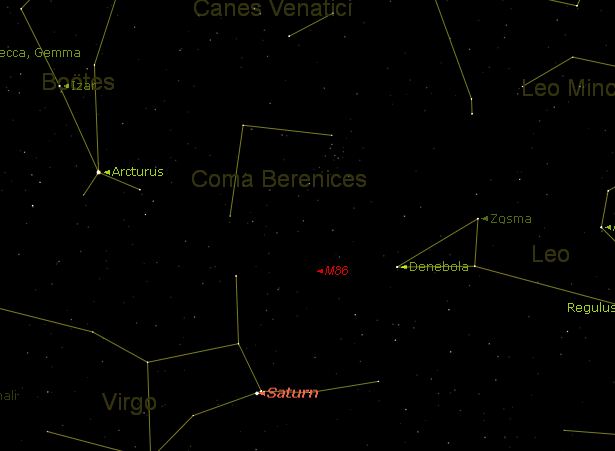
Well, I was slightly more successful in my galaxy hunting than I was in comet hunting. I found one. It took a long time. I was basically panning the sky in the area between the bottom of the constellation Bootes (basically, the star Arcturus) and the rear end of the constellation Leo.
My general search area
Finally, after a long time of searching somewhat aimlessly, I happened upon a very faint smudge in the sky. I had to look several times to be sure it was there. It was. I had found a galaxy! That got me excited, and I frantically searched the area nearby for another, to no avail. I did eventually end up back at the same one, however, which encouraged me to really memorize the stars I could see around it so that I could try to identify it once I got back inside.
I immediately went to my Starry Night program and searched the area I thought I was looking in to see what galaxies were in the vicinity. There were a few nearby, but judging from the arrangement of the stars, I’m pretty certain I was looking at Messier 87 (M87), an elliptical galaxy. I had seen an arc of three or four stars on one side of the galaxy and one bright one on the other side.
What I think I was looking at through my telescope
The sad news, if there is any, is that M87 is the biggest and brightest galaxy within the Virgo Cluster. Why is that sad, you ask? Because if it was that difficult for me to find M87, I don’t imagine I will have much luck finding any of the other galaxies. However, there was a very faint layer of clouds in the sky, so I am hoping that that was obscuring my view and that if I go out on a totally clear night, I will be able to find another galaxy! But here's to Messier 87 - the second galaxy spotted through my telescope!
I was excited to see all of the hype created by the so-called “super moon” – even if there wasn’t anything drastically different to see. I like it when the general population gets engaged in astronomy, as well as any opportunities to learn new things myself.
This past Friday was one of the best clear night skies we’ve had in a while. Winter tends to be very cloudy in West Michigan (and cold!), so I don’t get to enjoy the starry skies very often this time of year. Because Friday night was not only clear, but also happened to be warm-ish, and a day before the rise of the super moon, I decided it was high time to get my telescope back out! The moon was almost full, and was so bright. It’s so cool to be able to see so many details of the lunar landscape through the telescope.
I didn’t stop there, though. I realized that Saturn was also visible in the night sky, not too far from the moon. Last summer was the first time I’d ever picked out Saturn in the sky or seen it through a telescope. It’s so far away, and it still looks tiny through my telescope, but it’s so amazing to see those rings! There’s no mistaking Saturn for anything else – that’s for sure. What I just learned, however, is that Saturn was on edge for the past two years, so you couldn’t see the broad array of its rings like you normally can. Fortunately, that’s changed this year! I have a feeling I will be coming back to Saturn often this year like I did Jupiter last year. The night sky never ceases to fill me with wonder.
Okay, back to the Super Moon. In case you missed all the hype, the moon was at its closest point to Earth (perigee), and also happened to be a full moon on Saturday. It was the closest full moon we've seen since March of 1993. It rose on Saturday evening, not too long after it turned dark. It was really perfect timing. It was also a pretty clear night, with just a bit of haze. So, I tried to take some pictures with my camera. Here are some of the better ones I ended up with:
I spend so much time looking at planets and stars, and often don’t take time to reflect on the splendor of our own moon. It really can be quite beautiful.
As the weather warms up, I’m hoping to be able to get my telescope out on a regular basis and learn to identify some new things in the night sky. I found a list of things to look out for this month, so I’m hoping to be able to spot some more of those shortly. Primarily, I hope to be able to find Mercury – I’ve not been able to identify Mercury in the sky before. I also learned that spring is a good time to spot galaxies – namely the Coma/Virgo Super Cluster, also known as the “Realm of Galaxies.” After accidentally stumbling upon Andromeda last year, the idea of finding some other galaxies gets me excited! It’s simply amazing and humbling when you realize the enormity of what you are looking at, and to know that God created it all and still cares deeply for each one of us.
“When I consider your heavens,
the work of your fingers,
the moon and the stars,
which you have set in place,
what is man that you are mindful of him,
the son of man that you care for him?”